
In Conversation with Langley Sharp MBE
“The element of courage and humility as a leader; to know when to lead and when to follow.”
In conversation with Langley Sharp MBE
In Conversation with Langley Sharp MBE
Ahead of his keynote at Meyler Campbell’s 25th Anniversary Lecture, Chief Science Officer and Faculty Member Simmy Grover sat down with Mastered graduate Langley Sharp MBE to explore his extraordinary military career and leadership philosophy.
Together they discuss learning mindsets, balancing tradition with change, role-modelling values and standards, and the challenges facing modern leaders. Langley also gives a glimpse of the insights he’ll share at the lecture, and what excites him about speaking to the Meyler Campbell community this November.
You can also download and listen to this conversation as a podcast episode on the Meyler Campbell Podcast Series:
Key Topics:
- 00:30 – Langley shares insights from his extraordinary military career.
- 02:23 – Adopting a mindset of continuous learning as a leader.
- 06:40 – Balancing tradition and innovation in leadership.
- 10:43 – Embedding values and standards across an organisation.
- 17:52 – Key challenges facing leaders today.
- 23:26 – What excites Langley about speaking at the Anniversary Lecture.
- 24:42 – Value of coaching in leadership.
Full Transcript:
[00:00 – 02:22] Langley shares insights from his extraordinary military career.
Simmy: Hi, I am Dr. Simmy Grover. I’m the Chief Science Officer at Meyler Campbell, and I am delighted to be joined by Langley Sharp today. And we’re going to be talking a bit about his career, his experiences, and leadership, and what his experience and work can tell us coaches about how we can coach our leaders better. Hi.
Langley: Hi, great to be here.
Simmy: How are you doing?
Langley: Good thank you.
Simmy: So, I’d just like to start with a little bit about you. Can you tell me a little bit about your fascinating career?
Langley: Yeah. So, I joined the Army 26 years ago, at 23 years of age. I joined with a view of serving for three to five years, and a couple of decades later I finally left. It was an organisation I love. I often say I left on a high, an organisation I loved. I left for family reasons to settle the kids. I was an officer in the parachute regiment. I commanded every rank up to Lieutenant Colonel where I commanded one of the parachute regiment battalions. So, a unit of about 750 strong. Nine operational tours throughout that time. And the final two years of my career, I headed up the Army’s Leadership Center, which was a small team that did the thinking on behalf of the army, about all thing’s leadership. My old boss, the director of leadership for the Army, described [the Center as] our principal professional competency. So, they took that very seriously. So, had a great team there, and it’s a really nice way to finish off a career. I often sort of look back and think I had 20 years of practical experience and then be able to hone that and think about that.
What that meant at the end was, really valuable. As I say, I left three years ago, set up my own leadership consultancy and then came across Meyler Campbell a couple of years ago. Graduated the class of 2024. And, here I am, now as a professional coach and leadership consultant. And I love it.
Simmy: Great, and we’re very lucky because you will be giving our 25th Anniversary lecture in November on the 13th.
Langley: No pressure.
Simmy: Ha! So, what I’ve love to do today is talk a little bit about some of the things that you’ve mentioned in your book, the Habit of Excellence, and also talk a little bit about some of the things that you might be talking about, in the lecture. So, teasing the viewers on what they might hear when they arrive.
[02:23 – 06:39] Adopting a mindset of continuous learning as a leader.
Simmy: So, talking about your book, you mentioned – which something that I think is in incredibly amazing and lucky for someone to have – that you were able to learn nearly every day of your career. I just wanted to know how, you know, how can someone do that? How can they have that mindset? And especially as a leader, how can they ensure that they are learning nearly every day of their career?
Langley: Yeah, I could, I guess I feel very lucky that I had that, that sort of breadth of experience. And I think this sort of intensity of experience, throughout that career was where I’ve really found the value because we all learn from experience. We learn from training, we learn from education, but it’s everyday experience that we really develop and grow. And as I say that intensity all the way from sort of basic training through, operations, but the sort of breadth of our training and exercising and also working with the people that I had the fortune of working with from all walks of life, from all different backgrounds that come together with this sort of shared purpose. So, I often say that is the experience that really enabled me to learn.
And in terms of, as you say, sort of advice for leaders, how you develop yourself and how you learn. I think first and foremost, you have to be alive to it. You have to have your eyes and ears open, your antennas up. You have to want to learn. You want to develop and really gain from those experiences.
I think the next thing is, and it’s, I guess it’s a bit like coaching. You start with that self-awareness and that desire to improve. Then it’s about finding those opportunities. Where can you push yourself? Where can you stretch yourself? Where can you challenge? And then thereafter, it’s how do you learn from that? And I’ll be honest, I look back and although I feel I learned a lot, and as you say, pretty much every day, I think there’s more than I could have got out of it. And I see that now as a coach, you know. The ability to step back, and take the time to reflect and ask the difficult questions and analyse not just where things went right, but where things went wrong, where you failed, where you didn’t meet your own expectations or the expectations of others.
Gaining feedback from other people. We don’t get enough feedback in our professional careers. I think, you know, having a thirst for that, being self-reflective, but also reaching out to others and asking for other people’s perspectives and other people’s opinion, I think is really valuable. And that’s how we, how we truly learn. But it starts with that mindset, as you say, you’ve got to want to stretch yourself and develop. Yeah.
Simmy: Great. So you mentioned there coaching is one thing that can play a part and help leaders to keep their mind open to learning to reflect and maybe find those avenues of feedback. Would you agree?
Langley: Absolutely. Yeah. Yeah. It’s finding other people around you to offer you that alternative perspective or ask the awkward question. Because obviously we see the world through our own lens, and we bring our own experience into any context and the value of having other people that can help us reflect perhaps differently. I think will elevate that learning without a doubt.
Simmy: Do you think sometimes leaders feel, kind of scared to learn because it maybe shows that they don’t know something and that’s seen as a weakness or vulnerability that people don’t expect leaders to show?
Langley: I think so. I think it takes courage. It takes courage to ask, but it takes courage also to accept what may feel like criticism. So, I do think that it takes both courage and also, humility as well. I think key traits for any good leader, but particularly if you are asking for perspectives from those in your team, for those you are leading, for those that are following you. Because sometimes people may feel that that is, say, knocks that element of “I’m the senior one here. I’m the designated leader. I’m the most experienced one.” It takes real courage to say, “I don’t know, or I failed. Or, you know, how can I improve? What can I learn from, from your experience of being led by me?” And, again, I look back on my career and I didn’t ask those questions enough. And I missed out as a result.
[06:40 – 10:42] Balancing tradition and innovation in leadership.
Simmy: Great. Thank you. Thank you for that. So just moving on a little bit, leadership in the military carries with a deep history of tradition and kind of rituals and processes. And those can’t be ignored by its leaders, by its new leaders. You know, leadership is steeped in that. But in a lot of organisations, we encounter new leaders that want to put their unique stamp on the organization or on kind of, you know, the future of the organization. So, they will make a lot of radical changes and kind of ignore what has come before them, potentially to the detriment of the organization.
So, I wanted to ask you, how do leaders put their own unique stamp on their organisation, on their leadership, but whilst also respecting the traditions of what’s come before them?
Langley: That’s a really good point. I mean, every leader coming into a role almost has a duty to drive it forward. And with driving something forward inevitably that’s an element of creating change and perhaps doing things differently. But you can ignore the past at your peril. Because the past doesn’t ignore you, in the same way as individuals, we are the products of our experience. We bring that into the room every day. Same with organisations. And the military and the army is a great example of that, I think, you know, 360 years of history, well that plays out into, into the culture, the norms, the expectations, the way we do things around here. And I think you can ignore that, as I say, at your peril. And I think one thing the military is very good at is leaning on that history because it really does create that sense of who we are, our identity, belonging, our sense of self, sense of purpose, and lean on the experiences and the successes of our past, learning from the failures of our past. That really helps and sort of ground us who we are today. But it’s got to be balanced as you are alluding to there about what’s relevant here and now to drive the organisation forward.
And I think one of the biggest challenges that many leaders have, either coming into a position or throughout their time in that role, is working out what changes, what evolves and what endures and trying to find that balance. And I think it’s about recognising that past, recognising the impact, recognising what’s relevant and still should endure, but also having a clear vision of where you want your team or your organisation to get to, what needs to change, what that path is, what needs to change. But critically why, because change unnerves people. And if your history bakes into the way you do things, if you’re asking people to do things differently, that can create friction. So, you need to take people on that, on that journey, as we say. So, I think getting people to understand the why, you know, why you want to change, why you want to drive things forward, and how that helps you achieve better and be more relevant for this moment in time and achieve your collective vision. If you’ve got that buy in with your people, they’re more likely to go with you.
But it’s always a balance, because people have different experiences and different perspectives. Yeah. So, it is a constant communication.
Simmy: It’s a very dynamic situation.
Langley: Very dynamic. It’s got to be because, and the context in which one leads is changing all the time as well. So, I often talk about the art of leadership, is the judgment and balance in decision making your every single day. So, what’s relevant, what’s not, what’s appropriate, what’s not. Because things are always changing around you. So absolutely. It’s very dynamic.
Simmy: I like that model you use there: what changes, what evolves and what endures. I think that’s a really good way of thinking about it. Quite simplistic of those three things but breaking them down and in kind of a regular sort of scenario and thinking about it in that way, I think is quite powerful.
Langley: Yeah. And why each of those elements are relevant as well. Why do things endure from the past? Even if to some it may feel irrelevant to keep that going, there’s maybe a good reason why you draw that history or indeed why it really needs to change to propel things forward.
Simmy: Yeah. Yeah. So, the why is very important.
Langley: It’s always about the why!
[10:43 – 17:51] Embedding values and standards across an organisation.
Simmy: So, I’d like to talk a little bit about instilling values and standards in your organisation. You mentioned in your book that values and standards are embedded in the training and the assessment, at all levels within the military. What I want to talk about is to understand how organisations can embody the values and standards that they want to stand for.
Langley: It’s a challenge. It’s a challenge, not least because values mean different things to different people. How do you turn these words on a page into the live reality? I think the first step; I was doing some work with a financial services firm recently. I’d supported them in a culture and values review about a year ago. They’d evolved their values as a result. And then we had a team of senior leaders get together, and we’re looking at exactly this question, how do we embody this? How do we embed this into the culture? And part of it was lived anyway. It was being realised. It was just almost codifying that and improving on it. But I think the first thing we did is had a conversation around what are values? What values does, do values create? Why are they relevant? How do they work? Because you can overplay and underplay a value or the behaviours that sit, sit on underneath them. You can get values, organisational values that stand in contrast to one another. In the army, for example, they’ve got six values: courage, discipline, respect for others, integrity, loyalty and selfless commitment. Loyalty can sometimes stand in conflict with courage. You may find, someone’s done something wrong. Do you have the moral courage to stand up and say something? But that could disrupt your sense of loyalty to your team and the people around you. So, it’s understanding the role that first and foremost, that the values play. And also why are those values that you’ve chosen as an organisation, how do they support your purpose?
So, if you look at the values that the army has, and they’ve been codified for 25 years now and just undergone an institutional review, and they still stand as they are. They are fundamental to being able to deliver what the army does, its purpose, which is to fight and win wars in the land environment. And that is a team effort as a team sport. And that requires trust. It’s the foundation of your ability to operate effectively on the battlefield is you’ve got to have trust between people because, you know, lives are at stake. You want people to make the right decisions at the right moment in time, when you could be faced with sort of moral and ethical challenges under significant pressure. So, the values need to be baked in. So, you need to really understand how, how those values support that purpose and, how they need to be built every single day. Hence, the book was tied to the habit of excellence, because you can’t just turn up and live these values in that moment. You act instinctively under pressure. And the same way in business, you want people to act at a moment of acute pressure and a crisis and challenge. You want people to act the way you expect them to, to make the right decisions, but that’s got to be baked into everything you do. It’s the micro decisions and micro behaviours every single day.
So, to your question, how do you embed them? It’s a constant effort. It’s training and education. So, people understand that it’s about rewarding people. It’s about showcasing what good looks like, not just to the individual that’s deemed to have lived up to a value or the underpin in behaviours. But the ripple effect of communicating that to the wider team as well. It’s holding people to account. You know, I look back and I think some of my failures in my career are not holding people to account at that moment in time. And I’m not talking about the significant obvious transgressions; it’s just the microbe. When someone says something that’s slightly inappropriate, a bit of banter that’s gone too far, or someone turns up late again for a meeting, you don’t quite, you know, face up to it at that moment in time, you just let it slide. But as the old adage goes: the standards you walk by are the standards you accept or the culture you create. So, I think it’s the onus on leaders at all levels to really maintain those standards and help people to account for them.
A couple of aspects, one is about how we communicate the stories we tell. We talked about our history, and we use our history as a vehicle to tell the stories of and bring these values to life. You know, I’m often talking about events that have happened in our regimental past. For example, we talk through the language of courage, of selflessness or, professionalism. So again, it brings them to life.
And the final, and obviously most important way of embedding values is role model, is leading by example. And it’s the primary role of any leader is to lead by example, demonstrating what good looks like. And I think we often, when we talk about leaders and leadership, when often think about the senior leadership, whereas the reality is the majority of the workforce in any business are going to be influenced by the junior leaders around them. So hence why leaders at every level need to demonstrate what good looks like and influence those around them. And over time, you start to bake that into the culture of the organisation.
Simmy: Mm-hmm. Yes, I think also some organisations have issues where they may outwardly convey a particular kind of values and standards, and it may differ from how they behave internally. So, that consistency is also really important that you are well modelling outwardly, but also inwardly.
Langley: Yeah. And you also need to understand, and we talk about trust. It is not just about trust within your teams and within your organisations, but it’s trust to your external stakeholders, to your customers. In the same way from a military perspective. It’s not just around about trust in inter and intra teams, but it’s trust with the society we serve. Because we say, if you lose that trust, you lose your license to operate. Because they’re there to work on behalf of a society. And I think it’s the same in business. You need to understand how these values are perceived by multiple stakeholders, not just those within the organisation.
Simmy: I also just wanted to bring back that point you said earlier about habit because it’s quite easy for us when things are going well, it’s quite easy for us to kind of embody our values. But under pressure, that’s when it becomes really, really difficult. But if we’ve built the habit, as you said, it is more natural that we will go towards those values and that decision making even under pressure.
Langley: Absolutely. You know, the courage to make difficult decisions, or the courage to say, to hold someone to account, to maintain those standards. If you’re not used to doing that, and there’s a balance. You know, you’ve got to maintain that balance within the team. But if you’re not used to doing that, and then the pressure comes on and then you’re expected to make a significant decision, if you’re not used to doing that – and your teams around you are not expecting or used to you’re making those difficult calls – then you’re leaving yourself open.
[17:52 – 23:25] Key challenges facing leaders today.
Simmy: So the next question I’d like to ask you is thinking about some of the challenges that are facing leaders. I’m sure there are many, but if you could pick one that leaders are facing at this point in time, how will your talk address that challenge?
Langley: I’m going to slightly avoid the question in terms of narrowing it down to one.
Simmy: [Laughing] Okay.
Langley: But, the reason I say that is I think one of the biggest challenges that are relevant across all industries is the complexity of the environment in which people are operating and the breadth of challenges, and the uncertainty, the unpredictability of the environment that we’re all dealing with regardless of industry regardless of sector, and indeed regardless of seniority. There’s that sense that things are changing and the pressure to continue to perform in such a dynamic environment. So, I think it’s the multitude of challenges that people are facing is the issue. And I think we often suffer from a bias of the present in which we think we live in unprecedented times and things have never been as bad as the world is today. Whereas the reality is you can look back through generations and, you know, centuries, leaders will have had the same sense of concern, fear, pressure, anxiety, call it what you will, to perform. And what history has proven is that our ability to succeed in such dynamic environments is to work collaboratively, is to work as teams. And I think that’s beyond our superior intelligence as a species. I think our ability as a human race to scale trust and to scale collaboration from small teams to nation states really is what sets us apart.
And so how do we do that as leaders? And to your point about the talk, what I would like to do is to get people to think a little bit broader about leadership. Because one of the biggest failings of this now multi-billion-dollar industry that is leadership and leadership development, is that people far too often see it through the purview of the leader. And often as we were discussing earlier, a western perspective and the male dominated leaders, as our histories has viewed it. And we need to see leadership as a system, as a relationship. Because obviously if you have leaders, they are leading someone, they’re influencing someone, they’re influencing others. So what does that look like? What does followship look like? What does effective followship look like? And success is a collective endeavour.
You know, I look back on my career, nothing I achieved, I achieved on my own. It was always a team effort and leaders set the environment and create the environment for other people to fulfil their potential and to perform at their best individually and collectively. But followers – and it’s a role, not a position, I can come back to that – but followers, you know, they turn intent into action. So, they’re fundamental to how performance is enabled.
So the talk will look leadership, but from the perspective of followship, what it means to be an effective follower, what role they have to play in that collective endeavour. And the role, as I say, of leaders in creating the environment to create very effective followership. And I say it’s a role, not a position. I look back my time when I was a platoon commander stood in front of my first 30 soldiers, fresh out of training, and I was in command, so I was what we call command. So I was the senior person there, the ultimate decision maker. I was the one with the authority and the accountability of what the team did. But I was following almost every day because I was relying on the experience of the team in front of me. And they were advising me, counselling me, nurturing me, and developing me as a leader. And I was leaning on their experience so many, many days and weeks, you know, my first few months I was the follower most of the time, even though I was the sort of senior person in the room. And that experience, you know, continued throughout my career when I come out of the unit the tail end of my career. I would often be the senior person in the room, but I would revert to a follower role because there were other people around me that had the skills, experience, the knowledge to take the lead at that moment in time.
And I think again, it goes back to that element of courage and humility to know when to lead and when to follow. So hopefully the talk will explore some of those themes.
Simmy: That sounds fascinating, and it sounds like something, well, from my experience of the leadership literature is very under-researched and not talked about often the role that followers play. It’s an important one. You can’t be a leader without followers, but what you’ve talked about there about switching between a leader role and a follower role, I just think it’s, it’s very innovative and I’m really excited about what you’re going to be talking about. So, I’m looking forward to it.
Langley: Well, hopefully we’ll have a good conversation around it. And you’re right, academically, the followership research has only really come to a fruition in the last 20-30 years. Robert Kelly in 1988 in his seminal article in HBR [In Praise of Followers] was the one that really pushed the agenda. Others had talked about it before. But it’s still, as you say, in relation to the amount of literature out there on leadership, it’s vastly understudied.
[23:26 – 24:41] What excites Langley about speaking at the Anniversary Lecture.
Simmy: So, this is an area that you’ve decided to kind of focus your career on, your third act you could say. I just wanted to understand what you are excited about in terms of talking about, in the anniversary lecture, because I think often, you know, we can talk about different areas and you’ve just mentioned followership, but what really kind of gets you excited, you know, really gets you energised around this topic?
Langley: I’ve got to be honest, the bit I’m most looking forward to is the conversation. Because whenever I give talks, the value for me is in the question and answer, the conversation afterwards. So hopefully the talk ignites some sort of insight for people to look at things perhaps differently, to look at the way they view leadership differently, to look at what that means from a coaching perspective differently and how they can interact and get the most out of clients and the clients understanding the coachees understanding of leadership. But whenever I talk about these issues, again, people bring their own experience and their own perspectives into the conversation, and that’s a bit I love, not just be able to offer my perspective, but learning from others as well.
[24:42 – 25:50] Value of coaching in leadership
Simmy: Great. So we’ve touched a little bit on coaching earlier in this conversation, but I’d like to ask you where you see the value of coaching and what you’re trying to achieve?
Langley: I think what it’s opened my eyes up to is because we can see leadership, we have a more mature understanding of leadership, as I say as a relationship. It’s being able to use coaching to get people, including ourselves as coaches, to think more systemically. So not just they think about the role of the individual in front of us. And I know a lot of very good coaches do this anyway but understand what does that mean for their relationship with their teams and how their teams interact and how their teams affect the coachee. But also going back to your point about history, what do we learn from the environment? What do we learn from the organisational norms that impact the behaviours of the people in the room? And I think our ability to think more systemically and draw that out and enable our coachees to think more systemically is a real value both to them, but also to the, to the wider organisation.
Simmy: Great. Yeah. So how can a coach bring everyone else into the room as well?
Langley: Absolutely.
Simmy: Yeah. That sounds great. So I’m going to stop there, and I just wanted to thank you so much for your time today. Great to get to know you and talk about this fascinating topic. And I’m really, really looking forward to your lecture in November for our 25th Anniversary.
Langley: Thanks Simmy.
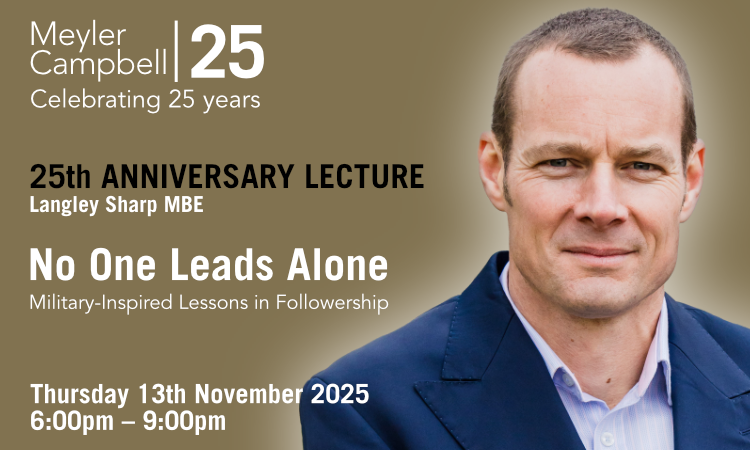
Interested in hearing more?
Whether you’re a leader or someone who is interested in the development of leaders then this is an event you won’t want to miss.
Register here ⮕ Meyler Campbell 25th Anniversary Lecture