Research & Publications
We’re delighted to present you with a curated selection of recommendations from the Meyler Campbell Faculty on their favourite reads (and listens) this year.
12(ish) Reads of Christmas
In response to requests from the community for recommended reading, we’re delighted to present you with a curated selection of recommendations from the Meyler Campbell Faculty on their favourite reads (and listens) this year. We hope you find something that appeals.
Jenni Emery’s, Ann Orton’s & Daniel Burke’s Recommendation:
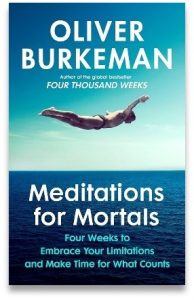
Oliver Burkeman (2025): Meditations for Mortals
Jenni: Oliver Burkeman (2025): Meditations for Mortals. Taken slowly, as Burkeman recommends, one short chapter a day, this book returned me to myself. It has that brilliant capacity to remind me of things I thought I knew in a new and fresh way that means I can hear them afresh, digest them, and actually put their wisdom into practice. All while smiling and remembering not to take myself too seriously. This is my most gifted book of the year by a mile and everyone – from the seasoned CEO of one of the largest retailers, to my daughter tackling her GCSEs – has found something shining and helpful in it.
Daniel: My recommendation is another vote for Meditations for Mortals by Oliver Burkeman. As it says on the (inside of the) tin: ‘Meditations for Mortals takes us on a liberating journey towards a more meaningful life – one that begins not with fantasies of the ideal existence, but with the reality in which we actually find ourselves.’ My copy is much underlined.
Liz Gooster’s Recommendation:
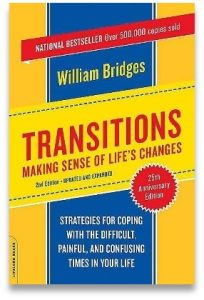
William Bridges (2019) Transitions: Making sense of life’s changes
William Bridges (2019) Transitions: Making sense of life’s changes. So glad I finally got round to reading this classic book on change, in all its messy, painful forms. Introduces a simple but immensely helpful 3-stage framework to help understand what we go through as we experience and process change. It draws on an impressively wide range of modern-day case studies and ancient mythology and references both academic and popular sources. Easy to read, insightful and very valuable to anyone facing significant change – or anyone coaching them!
Simmy Grover’s Recommendation:
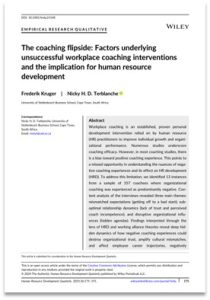
The coaching flipside: Factors underlying unsuccessful workplace coaching interventions and the implication for human resource development by Frederik Kruger & Nicky H. D. Terblanche.
The coaching flipside: Factors underlying unsuccessful workplace coaching interventions and the implication for human resource development by Frederik Kruger & Nicky H. D. Terblanche. Much coaching research focuses on the success factors for coaching, but we all know that we can learn so much more when things don’t go as well as expected. This is a unique qualitative investigation of 13 cases in which the coachees had a negative experience of coaching. The findings highlight three main themes: mismatched expectations, relationship dynamics, and organizational influences, which can help us to be better coaches and have more successful coaching outcomes. This is an open access journal article – that can be found here: Https://onlinelibrary.wiley.com/doi/full/10.1002/hrdq.21548
Penny Moyle’s Recommendation:
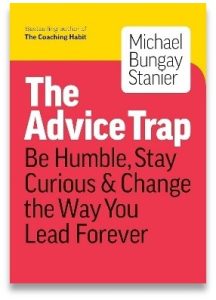
Michael Bungay Stanier (2020): The Advice Trap: Be Humble, Stay Curious & Change the Way You Lead Forever
Michael Bungay Stanier (2020): The Advice Trap: Be Humble, Stay Curious & Change the Way You Lead Forever. I found this gem via Michael’s brilliant TED Talk, ‘How to tame your advice monster’, which I now routinely recommend to new coaches and leaders of all kinds. Excellent advice, delivered in a humble and humorous way make, it an easy and engaging read. As we know, breaking these habits is far from easy. Michael’s methodology helps us understand both what drives our own ‘advice monster’, and what we can do to stop it getting in the way.
Helen Duguid’s Recommendation:
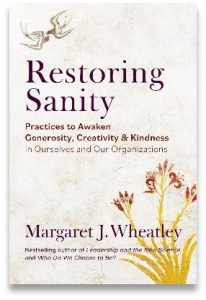
Margaret Wheatley (2024) Restoring Sanity: Practices to Awaken Generosity, Creativity, and Kindness in Ourselves and Our Organizations
Margaret Wheatley (2024) Restoring Sanity: Practices to Awaken Generosity, Creativity, and Kindness in Ourselves and Our Organizations. This is a book I return to rather than rush through. Its beauty lies in its simplicity and spaciousness. Wheatley writes with a quiet authority that doesn’t prescribe or instruct but gently invites a different way of being. In a world of speed, certainty, and solutions, Restoring Sanity encourages us to slow down, pay attention, and remember what it means to be fully human—both as leaders and as coaches. For me, it is a book that quietly reassures us that losing our sanity is understandable and restoring it is possible.
Catherine Devitt’s Recommendation:
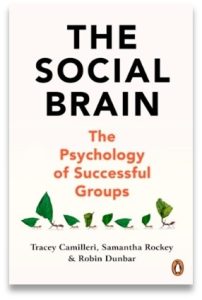
Tracey Camilleri, Samantha Rockey and Robin Dunbar (2024) The Social Brain – the psychology of successful groups.
Tracey Camilleri, Samantha Rockey and Robin Dunbar (2024) The Social Brain – the psychology of successful groups. This book combines, neuroscience, psychology and leadership expertise in a very accessible and engaging way. The storytelling and practical examples illustrate the important concepts at the heart of the book. It is a highly enjoyable way to understand the importance of the Social Brain in our work in helping to build high functioning and performing teams.
Simon Brown’s Recommendation:
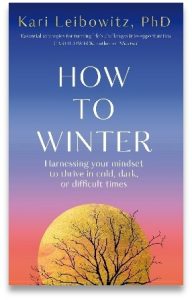
Kari Leibowitz (2024) How to Winter: Harnessing Your Mindset to Thrive In Cold, Dark or Difficult Times
This winter I have appreciated a number of the ideas in Kari Leibowitz (2024) How to Winter: Harnessing Your Mindset to Thrive In Cold, Dark or Difficult Times. Recommend from a fellow tutor, I do now look at winter in a different and more positive way – so has been life enhancing!
Keith Krasny’s Recommendation:
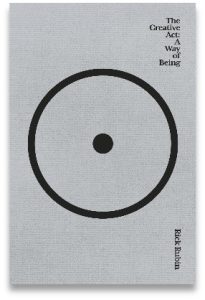
Rick Rubin (2023) The Creative Act: A Way of Being
I come back repeatedly to Rick Rubin (2023) The Creative Act: A Way of Being. Rick Rubin writes about artistic creation as a way of living and being. So much of what he expresses can apply equally to the way of being a coach. Who knows how many creative works have been mid-wifed by this book? I know of at least one new music festival that owes much of its inspiration (and perspiration!) to Rick Rubin’s clarity and wisdom…
Sheldon Daniel’s Recommendation:
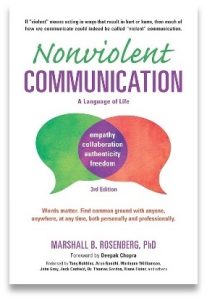
Marshall B. Rosenberg (2015) Nonviolent Communication: A Language of Life
Marshall B. Rosenberg (2015) Nonviolent Communication: A Language of Life. I discovered this book a few years ago and reread it this year because I wanted to apply some of its core principles in a workshop. It resonated more deeply this time due to the contemporary context, which emphasises expressing oneself honestly while also listening with compassion. The material seamlessly combined my “communication” domain and coaching, as the framework of “observations, feelings, needs, requests” can be readily applied in both contexts. Lots of practical exercises that can be used in coaching, in particular, to raise clients’ awareness of the embedded judgments and evaluations in even the most casual statements. It also contains this beautiful Rumi quote: “Out beyond ideas of wrongdoing and rightdoing, there is a field. I’ll meet you there.”
Penny Terndrup’s Recommendation:
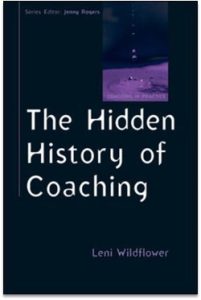
Leni Wildflower (2013) The Hidden History of Coaching.
Leni Wildflower (2013) The Hidden History of Coaching. The foreword by the series editor Jenny Rogers points out how little is often known about the roots of the craft we practice. I love the way Leni weaves the story of psychological movements together with real world context and then raises implications for coaching. Moving surprisingly seamlessly between Socrates, the Human Potential Movement and the Board Room, this is a fantastic resource for those supporting leaders into an uncertain future. As Leni says “Coaching is remarkably diverse but rests solidly on established principles. It has the capacity to make individual lives more fulfilled but could also have a transformative impact on society. Given its profound origins and the richness of its hidden history, we should expect nothing less of it“.
Richard Macklin’s Recommendation:
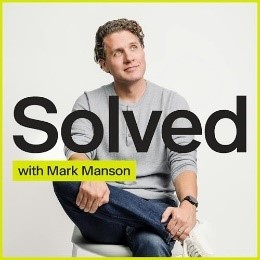
“Solved” by Mark Manson
Not a book for the shelf but a podcast, which I thought I’d share because I’ve found it very useful (as have a number of my syndicate members) and hope others may too: “Solved” by Mark Manson. Highly entertaining and very comprehensively researched. Tackling subjects like Purpose, Values, Stoicism, Procrastination and more. Each episode is a 3–4-hour in-depth conversation/tutorial so, like most books, not to be done in one sitting. For the ADHD among us (who can find volume reading a challenge), this is a great way to take in a lot of useful information and insights.
Des O’Connell’s Recommendation:
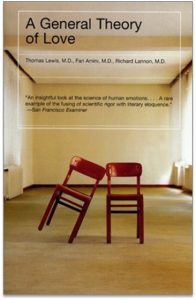
Thomas Lewis, Fari Armini and Richard Lannon (2001) A General Theory of Love
My pick would be Thomas Lewis, Fari Armini and Richard Lannon (2001) A General Theory of Love. Not new, but a beautiful exploration of the qualities that make us most human – our ability to connect with one another, to experience empathy and compassion; our capacity to love and be loved. A wonderful reminder of how we remain unique in a world of artificial intelligence. I fell in love with my limbic system after reading this book.
Sarah Martin’s Recommendation:
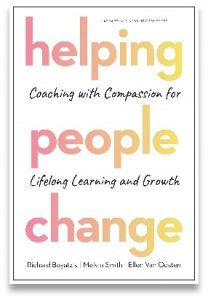
Richard Boyatzis, Melvin Smith and Ellen Van Oosten (2019) Helping People Change: Coaching for Compassion
My favourite is Richard Boyatzis, Melvin Smith and Ellen Van Oosten (2019) Helping People Change: Coaching for Compassion. It’s top of my list for many reasons, but mostly because I love the concept of a helping people uncover a “Positive Emotional Attractor” to connect with hope and excitement in exploring growth and capacity for change. Published 2019, enduring relevance especially in challenging times.
Kirstan Marnane’s Recommendation:
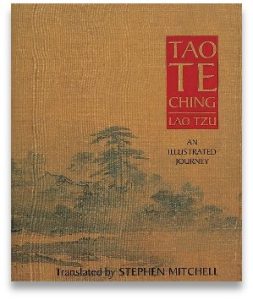
Stephen Mitchell (1999) Tao Te Ching: An Illustrated Journey
For me, it is Stephen Mitchell (1999) Tao Te Ching: An Illustrated Journey. I contemplate the chapters, one per morning, gaze at the beautiful illustrations – art from the great dynasties – and learn more about how to ‘be’ in this world. It’s my morning ‘pause’ and while I am neither Taoist nor Buddhist, the book reminds me of the great wisdom behind us, the masters whose shoulders we stand on, and that there is always another way to witness and be in this life.
Saiyyidah Zaidi’s Recommendation:
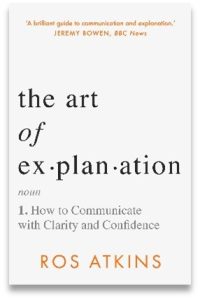
Ros Atkins (2023) The Art of Explanation: How to Communicate with Clarity and Confidence.
Ros Atkins (2023) The Art of Explanation: How to Communicate with Clarity and Confidence. It is an excellent book on how to simplify your message in a range of different mediums, how to ask more precise questions, and has an interesting take on feedback.
Saverio Grazioli-Venier’s Recommendation:
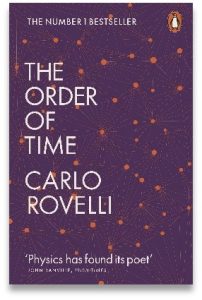
Carlo Rovelli (2019) The Order of Time
My recommendation is Carlo Rovelli (2019) The Order of Time. It takes a complex subject like time and makes it accessible. With reflections that can inspire how we live, coach, and lead – from letting go of a single, objective now, to exploring how meaning emerges from the relationship between events (not the events themselves), to reframing urgency and pressure (where what feels absolute is often a question of perspective). It’s beautifully written, deeply human, book.
Eyal Pavell’s Recommendation:
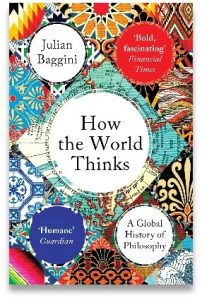
Julian Baggini (2019) How the World Thinks
I would like to recommend Julian Baggini (2019) How the World Thinks. Does what it says in the title, mind expanding and helps to understand other perspectives and worldviews, as well as our own.
Anna Phillip’s Recommendation:
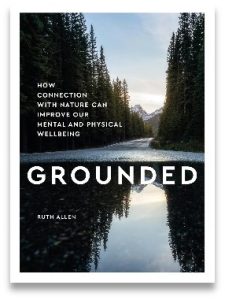
Ruth Allen (2021) Grounded: how connection with nature can improve our mental and physical wellbeing
I’d recommend Ruth Allen (2021) Grounded: how connection with nature can improve our mental and physical wellbeing. Through the lenses of presence, connection, movement, stillness, solitude, wild, mystery and perspective, Allen offers way markers for forging a closer relationship with nature, and in so doing, with ourselves. Many of our clients are looking for ways to remain calm under pressure, to manage themselves well and to maintain a sense of balance, resilience and perspective; Grounded offers insights and ideas that can help leaders to strengthen these qualities. Beautifully illustrated and with simple, practical exercises and reflective questions to draw upon, this is a book that offers fresh perspectives on ancient wisdom for current times.
Subscribe
Join our mailing list to be informed of the new Meyler Campbell Insight resources as they are published