Meyler Campbell Insight
Creativity and innovation are born out of risk and although the consequences of failure are different, what role does leadership and followership play in this space?
A question that is answered by Meyler Campbell Mastered Graduate Stephen Page OBE, who has been and continues to be an incredibly successful leader in a creative industry where innovation was a necessity to withstand the advance of big-tech.
The Chain of Disobedience

Our goal with the Meyler Campbell Annual Lecture is to spotlight an individual who inspires and challenges our community, and this year Langley Sharp MBE did not disappoint. His exquisite storytelling captivated the room. It started with a painting that highlighted the risks of the profession where he built his career: the difference between life and death. For many of us, the stakes are not so high, but the tradeoff between risk and reward is just as present. Creativity and innovation are born out of risk and although the consequences of failure are different, what role does leadership and followership play in this space?
A question that is answered below by Meyler Campbell Mastered Graduate Stephen Page OBE, who has been and continues to be an incredibly successful leader in a creative industry where innovation was a necessity to withstand the advance of big-tech. He spent 20 years as the CEO of Faber & Faber, and launched his own coaching practice in 2022, coaching leaders across many sectors including creative and cultural.
The Meyler Campbell 25th Anniversary Lecture was delivered this year by Langley Sharp MBE, former head of the Centre for Army Leadership. His clear and compassionate talk and personable presentation were thoughtful and well received. It was clearly the product of personal and institutional reflection over many years, and, like many, I admired his clarity and evident selflessness. As I listened, though, I wondered how this template, necessary for the extreme circumstances of the military, compared to my working and coaching experiences of the creative and cultural sectors. Is this model of Serve to Lead, of Followership and carefully delegated initiative, transferrable to more innovative and rebellious organisations?
In Rebecca Miller’s excellent new documentary[1] on the filmmaker Martin Scorsese, it is notable how often the expert leadership of the movie business does its best to thwart Scorsese. His artistry is not commercial, his methods expensive (at times), his interests upsetting. Yet his films have endured and some have made a lot of money. I thought of him as Sharp talked about the freedom to act afforded to soldiers in the British Army. How free? I wondered. Strategy appears largely set on the hill, initiative allowed on the battlefield. Scorsese’s successes were despite the strategies and parameters set by industry leaders. Making art is not such a straight road. Nor is innovating in a business or institution.
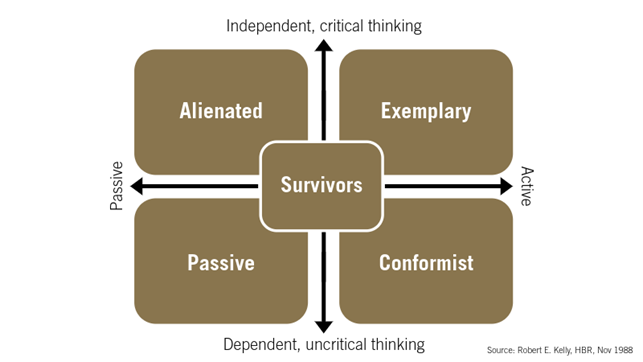
It was in a passing comment that I started to understand the struggle I was having with the neatness of this British Army model – a good and appropriate leadership template, no doubt. He presented a two-by-two. The grid mapped the attributes of types who made different kinds of followers.
The aim of the Army is to find followers who fit the Exemplary quartile (the clue is in their naming). The life and death realities of the Army requires it. Their attributes were: responsible, mission-focused, disciplined Initiative, highly professional, collaborates, confronts difficult issues, values-driven, holds others to account, trustworthy.
He then said, ‘there are of course some good attributes in each quartile’. These were the attributes associated with Alienated: independent thinker, self-assured, forthright, critical, confrontational, self-marginalising, undermining, disaffected.
And I thought, ‘Yes, some of the best people I worked with in publishing, and some my most impactful coachees, are like that, in all parts.’ They do not want to Belong. They want to be the exception not the rule. What may tie together some of the organisation – excellence of strategy, communication, transparency of aims, belonging – doesn’t cut it with them. They are disobedient to their core. And many creative businesses rely on their rebelliousness for their success. They are the outliers, those with rebel ideas, as Matthew Syed argues[2], and are differently motivated.
I was struck by the uniforms in Sharp’s photographs. His willingness to encourage independent thought from followers was undoubtedly sincere, yet necessarily it sits under a system of uniformity. There are clear reasons for this in the British army, but it is alien in creative and innovative organisations. Top left quadrant people often feel trapped by rules, and see uniformity of purpose as group think. They find it personally toe-curling and uncomfortable. Their disaffection can be defining to them, and makes them exceptional at creating essential value.
So how do we take this two-by-two, with its evident strengths, and deepen it for organisations more reliant on innovation and taste making?
At heart it requires managing different people differently. That’s hard, as it also requires knowing when this kind of rebelliousness is dangerous, when it stops being a culture of diverse brilliance, and allows toxic behaviour more damaging than it is productive. Tolerance of outlying behaviour can go badly wrong, and has to be in balance with supporting high quality top right quartile people as well. I led a creative business for over twenty years, and the hardest times were when this dissonance undermined the business, the most successful years came when we were all in stride with the productive discord that led to unexpected and original success.
So what are some of the things we as coaches might encourage in leaders to help them to lead organisations where exemplary comes from all quarters? Here are some ideas:
- Embrace difference – make clear that values, measures and motivations will vary between individuals, but that what we want to achieve is the same
- Safe challenge – create a culture that allows and encourages respectful challenge in all directions, including strategy and long term plans
- Clear and transparent communication – tell everyone what you expect of them, and ask them what they need to succeed
- It begins at the top – listen and challenge your own biases
- Create a culture that disagrees and then commits – hat tip to Amazon[3]
- Reward and celebrate the different kinds of behaviour you want to see – notice the many guises of exemplary, and ensure that status is about more than hierarchy
Many of these ideas arise from recent coaching conversations with people in creative and innovative organisations. It seems quite simple, but as Martin Scorsese says about film making, ‘There is no such thing as simple. Simple is hard.’ We are in times of rapid change and leaders face accelerating uncertainty. Sustaining a culture that holds differing kinds of exemplary is not easy but is essential for success. It is a daily challenge, like sailing in a storm, and requires permanent adjustment. Scorsese says of his craft, ‘Every scene is a lesson. Every shot a school. Let the learning continue.’ Leaders have to build a culture encouraging of challenge while holding a safe place for all to thrive. In my experience of creative and innovative organisations, that can’t be a monoculture.
Langley Sharp’s model embraces all this to a degree, and delegates some initiative, and encourages essential humility. It is clearly carefully modelled for the extremely high stakes faced by military personnel. But in the world of creative commerce, and technological and commercial transformation, a wider corridor of freedom is required for our most original thinkers. These cultures have, therefore, to be less uniform, more open to difference.
As Catch-22’s [4] anti-hero, Yossarian, says, ‘There was no telling what people might find out once they felt free to ask whatever questions they wanted to.’
[1] Mr. Scorsese, https://tv.apple.com/us/show/mr-scorsese/umc.cmc.4a06j5lm5pxny9nx505zo5g0y
[2] Rebel Ideas: The Power of Diverse Thinking, Matthew Syed (June 2021)
[3] https://www.youtube.com/watch?v=vYBfAqqQPj4, Jeff Bezos explains what it means to disagree and commit, StartUp Archive, Youtube, October 2025
[4] Catch-22, Joseph Heller, 1961

About Stephen Page
Stephen Page is an Alumnus of Meyler Campbell Mastered with over thirty years in the publishing sector, most notably as Chief Executive of Faber & Faber.
Stephen launched his own coaching practice in 2022, coaching leaders across many sectors including creative and cultural. https://stephenpagecoaching.com/about/
Subscribe
Join our mailing list to be informed of the new Meyler Campbell Insight resources as they are published